How Can Eurythmy Reach Everyone?

An Interview with Theodor Hundhammer at the Goetheanum
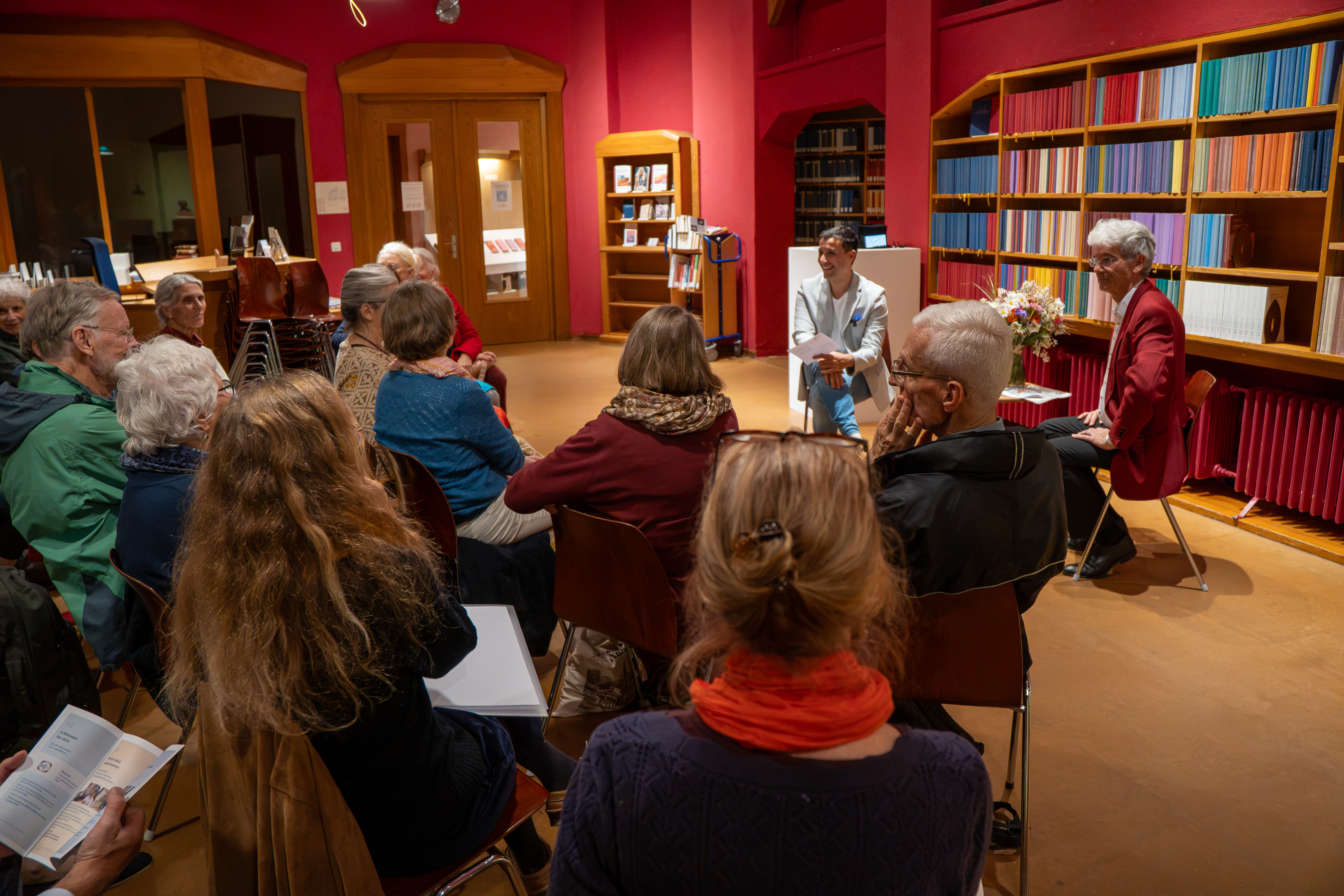
Nicolas Prestifilippo in conversation with Theodor Hundhammer
Eurythmy in Conversation, Goetheanum, 15 October 2026
How can people discover Eurythmy as something that belongs to their own lives? Theodor Hundhammer speaks about his path from aircraft engineering to Eurythmy, the beginnings of Eurythmy4you, and ways in which people can experience inner movement for themselves. The conversation moves from personal experience to questions of teaching, community and new ways of practising.
This is an edited, shortened version of the conversation. The complete interview is available as a PDF to read, download and print.
Read or download the complete interview as a PDF ↓
Contents
- From aircraft engineering to Eurythmy
- What Eurythmy can offer society
- Discovering Eurythmy through your own experience
- Understanding, imitation and experience
- Eurythmy4you: practising online and together
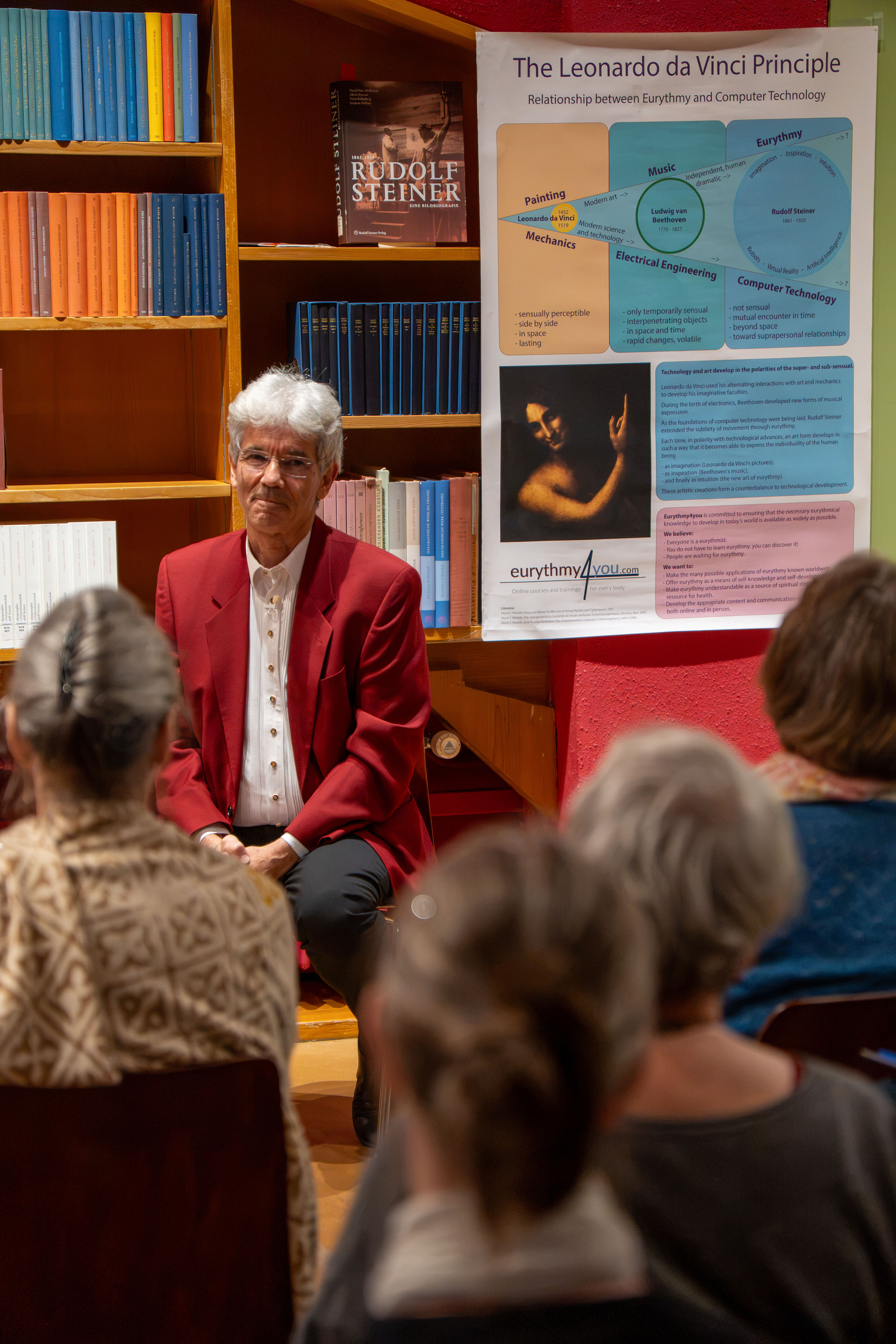
- Art, technology and new forms
- Experimenting further with Eurythmy
- Another conversation for Goetheanum TV
From aircraft engineering to Eurythmy
Nicolas Prestifilippo: You studied aircraft engineering and later Eurythmy and Eurythmy Therapy. How did that change come about?
Theodor Hundhammer: My interest in aircraft began when I was a child. At 17 I was allowed to take up gliding, and after leaving school I studied aircraft engineering. I thought: I’ll study until I find the meaning of life – and when I find it, I’ll follow it.
After a few years, I realised I wasn’t finding an answer that way. I left university for a time and worked backstage at the Goetheanum. That was where I first encountered anthroposophy. Later I returned to my engineering studies and completed them. I worked as an engineer, but the question of what kind of work truly belonged to me remained.
A friend was studying Eurythmy in The Hague. At first I was sceptical. At the same time, I sensed that there was something very profound in it. When I was wondering whether to go into visual art or human resources, someone jokingly said, “Why don’t you become a storyteller?” I replied, “Before I become a storyteller, I’d rather study Eurythmy!” At that moment I knew: this is my path.
Aircraft engineering and Eurythmy are very different, but both are concerned with movement and form. I am interested in how forces work and how something takes shape. In Eurythmy, that attention is directed towards the human being: movement, speech, music and what is expressed inwardly through them. My later work in Eurythmy Therapy and therapeutic practice deepened the question: how can movement do more than look beautiful – how can it stimulate and bring order to something within us?
What Eurythmy can offer society
Nicolas: Eurythmy has been around for more than a hundred years, yet it reaches relatively few people. What might help it speak to more people?
Theodor: Perhaps we should ask ourselves: Is something still missing? Is something not yet interesting or developed enough to make people respond? Is there something waiting to be born so that the spark can catch? The first question need not be why people do not come. Perhaps we need to discover what still wants to emerge.
To me, Eurythmy is not something that belongs only on stage or in a specialist training. It is connected with movements everyone knows from life. We speak, listen, breathe, stand upright and move towards one another. Forces and gestures are at work in all of this, and we can explore them through Eurythmy.
When people discover something of their own in it, their encounter with the art changes. Eurythmy no longer needs to be justified through explanations first. It can become interesting through an experience: “I know this – and yet I’ve never noticed it in this way before.”
The task is not simply to persuade as many people as possible to appreciate a finished form. We can look more closely at the questions that matter to people and how Eurythmy might respond to them. That calls for artistic work, research and a willingness to look for new ways in.
It also changes how we think about our own work. We cannot assume that an audience already knows why Eurythmy matters. We need to create an encounter in which something becomes visible and can be experienced. Then interest can arise from within, along with the wish to explore further.
Discovering Eurythmy through your own experience
Nicolas: You say that Eurythmy is present in every person. How can someone experience that without any prior knowledge?
Theodor: I can ask someone: “Take your hands and let them flow upwards.” It is a simple movement that many people can do straight away. Then I ask: “Can you feel that? Do you notice that it brings you into your feet?” People often notice that moving upwards also has an effect downwards, bringing something into their feet.
That interests me: the outer movement is only part of what is happening. At the same time, there is an inner activity and a counter-movement. When we pay attention to them, a simple gesture becomes a discovery. We do not need to start with complicated terms.
It is similar with the difference between flowing and radiating. I can experience flowing into a sound, and then something unfolding from the heart through the arms. These are not abstract explanations; they are experiences we can observe together and describe more precisely.
The challenge often comes afterwards. People experience something unfamiliar and say, “Yes, I can feel that.” Then it quickly becomes ordinary. Yet there is a question to explore: What exactly is happening? How can I find it again, change it and relate it to speech and sounds? If we follow that further, the experience stays alive. The point is not to impose an explanation on perception too quickly. First we can observe what is actually happening: Where does the movement begin? What changes in the way the body feels? What relationship emerges between above and below, between expanding and gathering?
Understanding, imitation and experience
Nicolas: Should Eurythmy be learnt mainly through imitation, or is there another way in?
Theodor: I don’t see it as an either-or. For children and young people, imitation can be exactly right. They join in, experience movement and enjoyment, and many things develop quite naturally. I saw this at the youth Eurythmy festival in Witten this year: there was so much strength, joy and musicality that I felt nothing was missing and I wasn’t needed there.
With adults, I am also interested in the question: what is happening in me when I move? The arms do not simply display a form that I copy from the outside. They can make visible what is active within me. Discovering that activity makes the movement my own experience.
This does not mean that showing and copying have no place. They can provide guidance. But if they determine the whole learning process, I may overlook what is happening inwardly. I also want to invite people to notice how they bring a movement about and what changes in them.
For teaching, it helps to start with concrete experiences and find language people can understand. Specialist terms may matter later; first, there needs to be an experience. When someone thinks, “I know this from within myself,” that can lead to an interest in exploring further and getting to know Eurythmy more deeply.
The conversation also touches on an idea about reality: a statement often has an opposite side that can also be true. Only when we look for both sides and bring them together does our view become wider. For teaching, that means we should not decide too quickly that one way of learning is right for everyone. Depending on the person and the situation, imitation and personal discovery can belong together.
Eurythmy4you: practising online and together
Nicolas: Eurythmy4you does a lot of work online. How did it begin?
Theodor: Eurythmy4you went online on 14 October 2017. We wanted to make Eurythmy and Eurythmy Therapy accessible to people wherever they lived, so that they could discover and practise them. Over the years, this has grown into a platform with courses, exercises and many videos.
Working online does not mean being alone in front of a screen. Our courses include live meetings, opportunities to share, and time to practise between sessions. Participants bring their observations and questions. A video then becomes part of a learning journey rooted in personal practice and meeting one another.
Digital courses make it possible for people in different countries to learn together. We work in several languages, and people can watch the material again. That is especially helpful when someone wants to follow a movement once more at their own pace.
At the same time, meeting in person remains important. In the same room, we can work together, notice movements directly and respond to one another. Online and in-person work offer different possibilities. For me, they complement each other: digital resources open doors and provide continuity; meeting face to face brings a particular presence to the work.
What matters to me is that people do not simply consume content, but begin to do something themselves. Practising, sensing what follows, asking questions and sharing experiences – that is how Eurythmy can gradually become part of one’s life.
So the work is more than a collection of recordings. Videos offer ideas and make it easier to revisit an exercise; courses give learning a structure, and live meetings provide a place for questions and experiences. In this way, a short impulse can grow into a regular practice.
Art, technology and new forms
Nicolas: What changes when Eurythmy is filmed or taught online?
Theodor: A camera can make movement visible, but it does not automatically show everything that happens in a space. If Eurythmy is filmed only from the front and from one fixed viewpoint, it can look static. I am interested in how we can shape movement in space and its relationships so that they can also be perceived on film.
This is an artistic question as well as a technical one. Which viewpoint helps? How can the space remain alive in the image? Where does technology support perception, and where does it distract from it? Technology should not replace art. But it can prompt us to ask more carefully what we want to show and how.
I have seen how enriching it can be to bring Eurythmists together with people who do not practise Eurythmy. At a meeting in Moscow, for example, we worked with a Russian ballad. Our different experiences did not get in the way; they gave us a shared starting point.
A shared performance at the end can also make something visible that is difficult to convey in words. When people shape a movement together, they experience rhythm, attention and working with one another. Moments like these show that Eurythmy is not only something to watch. It can be something to take part in.
New media challenge us to look again at our habits. That can be uncomfortable, but it opens up possibilities. We can find forms that let people see and hear Eurythmy, try it for themselves and talk about their experiences.
Artistically, I want to make sure that movement in space is not reduced to a series of outer forms. It lives through relationships and transitions. A camera or digital format has to translate these qualities in a new way. Better technology alone will not do that; it takes thoughtful design and a willingness to experiment together.
Experimenting further with Eurythmy
Nicolas: What new forms would you still like to try?
Theodor: I want to find ways of inviting people to become active themselves. One example was a Eurythmy request concert: people in the audience could offer words and ideas, and we responded to them directly through Eurythmy. It was demanding and not always comfortable. But that was part of what made it lively – we had to listen carefully and find a form in the moment.
Experiments like this are not about making Eurythmy merely more entertaining. They can show us what abilities and questions arise in an encounter. What happens when an impulse is not decided in advance? How do we respond together? And how can a spontaneous answer become an artistic experience?
Small digital tools can also encourage people to practise. We have, for example, developed an app with short vowel exercises lasting one or two minutes, arranged in different levels. An exercise like this cannot replace a course or personal guidance. But it can offer a simple beginning and help people practise regularly.
I am still at the beginning of finding ways to describe Eurythmy so that people can immediately understand why it might interest them. The right words and forms do not emerge at a desk on their own. They develop when we try things out, listen and continue working together. The same applies to digital tools: they can make it easier to begin, but the essential thing is our own attention. A one-minute exercise can open a door; what follows depends on returning to it, sensing and doing.
Perhaps that is the most important invitation in this conversation: Eurythmy need not remain something unfamiliar. We can discover it through our own experience – and from there find new ways of sharing it.
Another conversation for Goetheanum TV
A second conversation for Goetheanum TV took place on 3 November 2026. It is expected to be broadcast in February 2027. We will share the broadcast date in our newsletter as soon as it is known.
Sign up for the English newsletter
The complete interview
This shortened blog version cannot include every thought and turn in the conversation. Here you can read the complete interview in its verbatim long version as a PDF. You can download and print it.
