
Course Content
-
Certificate Course - Info Section + Articles
-
Husemann Friedwart
-
-
Handbook
-
Handout English
-
Handbuch Deutsch (German)
-
คู่มือฉบับภาษาไทย (Thai)
-
-
1. Affirmation and Negation
-
2. Sympathy and Antipathy
-
Introduction
-
Deepening
-
Questions and Answers
-
-
3. Love and E
-
Introduction
-
Deepening
-
Questions and Answers
-
-
4. Hope and U
-
Introduction

-
Deepening
-
Questions and Answers
-
-
5. Knee Bent and B
-
Introduction

-
Deepening
-
Questions and Answers
-
-
6. Rhythmic R
-
Introduction
-
Deepening
-
Questions and Answers
-
-
7. Head tilt and M
-
Introduction

-
Deepening
-
Questions and Answers
-
-
8. Dexterity and E
-
Introduction
-
Deepening
-
Questions and Answers
-
-
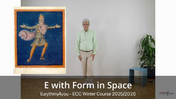
9. E with Form in Space
-
Introduction
-
Deepening
-
Questions and Answers

-
-
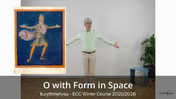
10. O with Form in Space
-
Introduction
-
Deepening
-
Questions and Answers
-
-
11/12. HA – Laughing and AH – Reverence
-
Introduction H-A and Laughing

-
Introduction A-H and Reverence
-
Deepening

-
-
Runthrough and Zodiac
-
Runthrough 1-12
-
The Exercises in the Zodiac
-


Questions and Answers
Great questions also in the chat.
Do I stop?
Same question always with antipathy.
Can I also stop with yes?
So how do I start?
So, you can take it as an exercise for a life situation.
Yeah?
And then maybe you only practice no for a while.
Yeah?
So you stand, breathe, concentrate, feel your light, feel that you want to be grounded but you are not able to feel down but at least it would be so nice to have a great shirt.
And then you just do, no.
Yeah?
And again, no.
And you try to feel this feeling and to get courage to say no, maybe.
Then if you have practiced this, maybe it's sufficient, or you feel the urge, and now I want to say yes, now I dare to bring my no into the world and I say yes to myself, to what I have practiced.
So my answer is invitation to be playful when you do it as a self quest.
And when you want to do it therapeutically, when you feel I'm short of with someone short of where you feel that environment is pulling so strongly and you like a dog run from one to the other, then it could be good to take the yes first, to really grasp firmly what is there and end with the no, with the force to really be with yourself.
So if you do it as an exercise with a client, I normally start yes and end with no because the no really I'm sure that now I'm with myself.
When I end with yes, I'm not sure is it really my yes or do I already lose myself again.
Question was how to begin.
If you do this as a therapeutic exercise, I would start with the yes to collect the situation in and not directly start with the no.
Because then you already take a distance but you want to bring the thing in first.
So, yes, I take you into my sphere.
Yes, light come and come into me please and ground me.
No.
Oh, affirmation, negation.
Short answer but I think I have touched a few things around it.
Hopefully.
Next question Elisa.
In the book you have the description of the exercises, how you do them, yeah?
And then I repeat all exercises again in the book from the point of view what are they good for.
And the symptoms for yes and no is a short breath.
You cannot really take time for deep breathing, you breathe up here.
And the sympathy, antipathy symptom is you take air into your digestive system and then you must gerp, yeah?
Air is coming back out of your stomach.
And then you can start to think what's behind the symptoms and then for the yes and no it's when you are very awake in your nervous system, in your thinking, about possibilities, obligations, yeah, which pull you out.
Your nervous system and your sense system pulls you into the world.
You try to understand things, you know what has to be done.
And this you want to try to bring into yourself in such a way that instead of pulling you out, it gives you freedom in your acting space in your hands and feet.
And with the sympathy antipathy it's more that you, it's not so much pulling you out but you try for some reason, you are too, let's say, hardened for some reason, yeah, a shock, a trauma, a fear which has become a bodily behavior.
And then you try to bring your soul in by, into your digestive system.
It's more into your movement system, the ethericness, the warmth system.
And this you do by warming your body, letting your soul flow in such a way that the body wants to flow, yeah, that your warmth creates a seed for your soul and you do not have to try to pull yourself into your warmth system but you notice I'm already there.
I'm already there, I can unfold.
Yeah?
And that's also, Leo Baer spoke about left and right, that archetypally the right side is the top down side, the stiff side, the doer side, male side and that's more the hardened one.
And the left side, archetypally, would be more the one, the receptive side, the listening side, receiving energy from the earth, intuition from there, filling the heart.
And in the exercise we somehow practice that the left side is not stiff but allows to become carried.
And as Liova wrote in the chat, becomes very stable but not because it's hard.
And the right side, which often is hard, becomes softened.
That's why I recommend to keep the sides like this, to say hello to the archetypes in us in such a way.
And they then understand and translate it into a full body story.
Which then has to do with top down, what we practice in our left right.
To the sagittal plane in Sagittarius, think, yeah, Look, the sagittal plane, we had this decision, I decide to go somewhere and I think, and the picture, the sagittal plane is here from sagittarius, which means arrow in Latin.
That's the definition of just the arrow flies in the plane which is defined by gravity between left and right.
It's exactly a vertical plane.
So left and right come together and when we do the oh, that's actually, as you say in neurogenital therapy, that's bringing the I in because I feel myself in my whole uprightness.
And there the Sagittarius plays.
And the yes and no again touches this plane in two different ways.
So I can feel this here and not just put my foot back, no.
I feel I go out and the whole inner of my foot now touches the sagittal plane, Sagittarius.
I come back, I feel the inner of my left foot, and I feel the plane, or maybe the foot comes first, I feel the plane, and then I feel it in me, And then I'm exactly in this Sagittarius, plain quality, which is also an incarnation decision.
And this in Sagittarius from the thinking path.
That's this incarnation of my light forces into the world.
Okay, so I also covered Nisha and the perfect example that these things can be combined not intellectually but that they can start talking to each other and we are allowed to listen.
Bookmarks